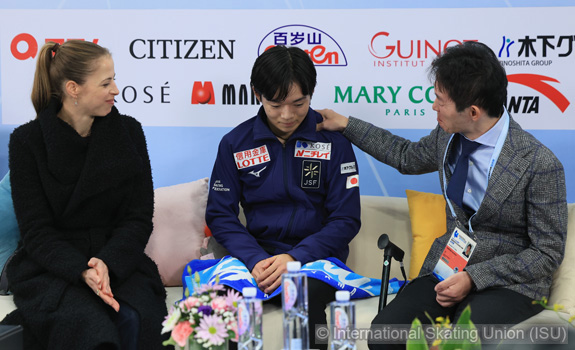



Carolina Kostner: skating, coaching, inspiring - a legacy in motion
March 25, 2026
By Reut Golinsky
Photo © Yeseul Park, International Skating Union (ISU)
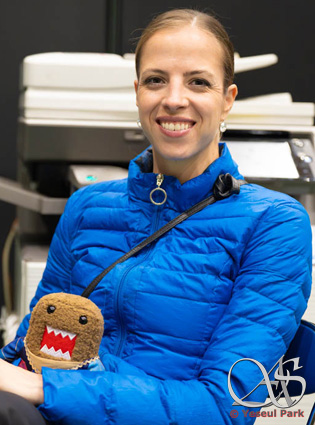 She works as a coach with Yuma Kagiyama, is involved in mentoring and supporting Team Italy, and still performs herself. During the Olympic Games in her home country, she was also a torchbearer, an ambassador, and more. Earlier this season, Carolina Kostner found time in her busy schedule to talk with us about her life over the past months.
There were so many topics I wanted to cover with you: your role as a coach, your work as an ambassador for the Games, and, of course, your own skating.
Indeed, it feels like wearing several different hats, but all of them give me the motivation to smoothly transition from one to the other. For example, exploring my own skating helps me pass on inspiration and motivation to the skaters, and the process works both ways. The same applies to my involvement in the Milano-Cortina 2026 preparations. As an ambassador, they asked what I preferred to do, and my role was mostly about communicating the Games and sharing my story. My favorite part was visiting schools, sitting down with kids, and letting them explore what the Olympic Games mean to them. I gave them information, taught them the difference between the Olympics and Paralympics, and discussed Olympic terms and disciplines. It was amazing to see how interested they were; you could see their eyes sparkle as they drew motivation and inspiration from my stories.
Winter sports are not as well known in Italy as summer sports because of the climate and geographical location. There is very little connection to winter sports in the south of Italy. So our wish was to reach the population, especially kids, and make them feel that these are their Games too. It's not only Milan, not only the North, and that's how the Ambassador program was born, from a desire to unite the population and make everyone feel like participants. For example, the mascots were originally drawn by kids in schools.
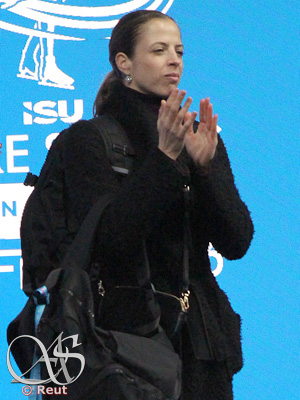 My wish is that these Games could bring joy to our country, but also inspiration for our younger generations, just like they did for me when I was a kid. I hope we could spark some dreams and give kids a reason to get involved in sports and be guided by them. Not necessarily only at a high level, because through sports you can learn to make friendships and strive for excellence, no matter what you choose to do. So, basically, that was my goal.
Before we move to talk about your work as a coach I wanted to ask you about your own skating. Do you still find time to practice? What does skating mean to you now?
I'm finding a way to explore what skating can be for me beyond competitions. In Italy, we have had and still have exhibition shows. But mostly, if you're a figure skater, you're known as an Olympic athlete. Yet, personally, skating means so much more. It's an art form. It's my way of expressing myself. You know, we all get older, life changes you, life happens, and it's fun and interesting for me to discover what skating can be for me now.
Last summer, I performed in a few shows, and I created a piece dedicated to my rite of passage. The Olympics were happening in Italy again after 20 years, and for me, it was almost like closing a circle. So I was truly reflecting on how I can slowly step back and leave the scene to the new generation, who have really improved and fought hard. I want them to have their moment. That piece was dedicated to them. I performed it once in Italy during a summer show, and then again at Shizuka's "Friends on Ice."
Unfortunately, I didn't see videos from that show, only photos. But I was planning to ask you about the very special group number you had there, which was dedicated to the Turin 2006 Games.
Yes, it was a very emotional piece. Stéphane choreographed it. I remember how Daisuke and Stéphane entered the ice from a different spot, while Shizuka and I waited together. 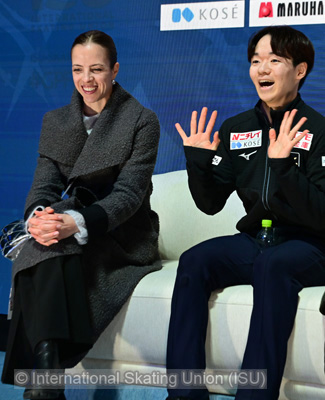 It's hard to put into words, but each time Shizuka went out onto the ice ahead of me, I would wipe my tears away. Then at the end, when all of us were together in a circle, it was incredibly emotional. It wasn't about showing what we could do or how well we skated, but simply a moment of appreciation for each other. Every one of us has done so much for figure skating, in our own way and together. Having the chance to perform that program felt very special. And it was so special to have that moment for ourselves and just reflect on twenty years of our dedication.
I was actually talking to Shizuka, and we noticed some parallels in our stories. Her first Olympic journey wasn't smooth (she finished 13th in Nagano, in 1998) and she really had to fight for her results. It was interesting to hear her story again, even though I'd heard it before. But now, being more mature and on the other side, you see things with different eyes and new emotions.
And, of course, I wanted to ask about your work with Yuma. I have to say, I was really impressed with how ready he came into this season, not only physically but also artistically. He prepared two great, "Olympic" programs, especially his free skate. When I saw it for the first time, it was just a small YouTube frame video, but I already had goosebumps, it was so, so good...
Of course, first and foremost, we were looking for something that would motivate him, would help him find his love for skating, because he's someone who completely embraces skating. This version of "Turandot" we're using is a short version of a longer new ending to the opera composed by Christopher Tin.
Yes, I read the story and also that it was you who contacted Christopher Tin, and that it was initially your idea.
Yes, Lori (Nichol) has used many different pieces composed by Christopher Tin. When I saw on X (formerly Twitter) that he was enjoying seeing his compositions in figure skating, 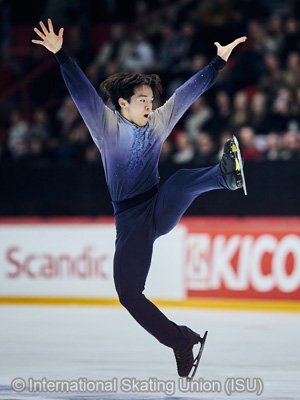 I reached out to him. First of all, I wanted to thank him for creating something so skateable and majestic. And so I wanted to encourage him to keep contributing, to keep composing. When we realized he had recently composed a piece of opera but we couldn't find it anywhere, I gathered my courage and thought: "Well, I'll just ask. The worst case scenario is he'll say no." But he actually provided us with a version of the recording. Then, when he sent us the video of the performance, he said: "I would be thrilled to create a four-minute version for Yuma." So we collaborated for many weeks, trying to find the best sequence of elements.
So you developed choreography while he was working on the musical version to fit it?
Absolutely! And it was very special for us to see Christopher's enthusiasm to create art that goes beyond just his own music, wanting to embrace the performance and the magic of the Olympic Games. His generosity to dedicate so much of his own time was incredible. Then, of course, the cherry on top was the opportunity to visit him at Abbey Road Studios during the recording. Seeing it live, feeling it, especially the brass... It was so close and so vibrant. It was truly special. We're so thankful for his generosity, for giving us access to his music. You could see his excitement, his energy, how he organized this big orchestra and choir, how he communicated his vision to the artists, and how he worked on improving the versions. For us, it felt a little like what we do in practice. It was very special to experience, especially in such a historic place. We felt truly inspired after being in London and watching him work.
Christopher Tin, along with his wife and daughter, also came to cheer for Yuma at the Olympics, and tenor Clay Hillay even traveled all the way from Vienna to watch him skate. We were all really impressed by the enthusiasm, belief, and support Yuma got, and we hope to give that back someday.
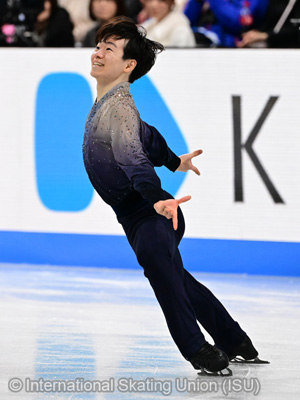 I loved how fresh and modern this version sounds. It has the right balance of something new and different, while also maintaining elements that are long loved and recognizable.
For sure, Christopher has given his own personal take on the ending while also paying homage to Puccini, who was never able to finish this opera himself. He told us how honored he felt to do that, and how he wanted to pay tribute. In his 17-minute version, he weaves in and out of the themes and arias that come before. It was very special to witness. It's his own interpretation and you can see his personality come through, along with his joy for creating art and music. His artistic generosity is truly remarkable. And I think Yuma feels that, you could see right away how much he really enjoyed practicing and skating it.
Yes, we spectators can also see and feel how much he loves this program. What you've created is truly unique and special. You talked about motivation, about Yuma's love for skating. How do you succeed in motivating your student, for example, to compete against someone like Ilia Malinin, who displays "technically impossible" content in competitions?
Skaters appreciate the strength of each competitor, and they actually motivate each other to catch up. You try to figure out what you can do better, where you can be the best. So I think having strong rivals is very important for your own improvement. Of course, competition is competition. At the end of the day, you first compete against yourself - your own fears, doubts, and limits, or the limits you set for yourself. Then comes the competition, and whatever happens, happens. Beyond the result, you gain experience. You put out the emotions you can convey and make others feel, and the lessons you learn along the way carry on into your future life as well. Of course, we all dream of a medal, of winning, for sure. As an athlete, you compete to be the best. But first of all, it's about being the best you can be. And then aiming for the medal.